Building a local discovery and booking system around one trainer's way of helping people move.
Oren's work is personal, patient, and built around what each client can safely do today. Tailored Approach helped turn that philosophy into a public system where people can understand the fit, explore specialized coaching, confirm local availability, and take the next step without the business losing the request behind the screen.
A customer-facing website connected to the work behind booking.
The project combined positioning, health-aware content, service and local-search architecture, technical SEO, responsive design, and a backend scheduling workflow. The page count is one implementation detail—not the measure of the project.
Business
Owner-led personal training practice
Market
Overland Park and Johnson County, Kansas
Customer focus
Strength · Mobility · Joint-aware fitness
Service architecture
6 focused training programs
Local architecture
9 Johnson County city guides
Public website
20 canonical pages · All live
Booking system
Calendar availability · Sheets lead recovery
The customer experience
Lead with the person and the kind of help he actually provides.
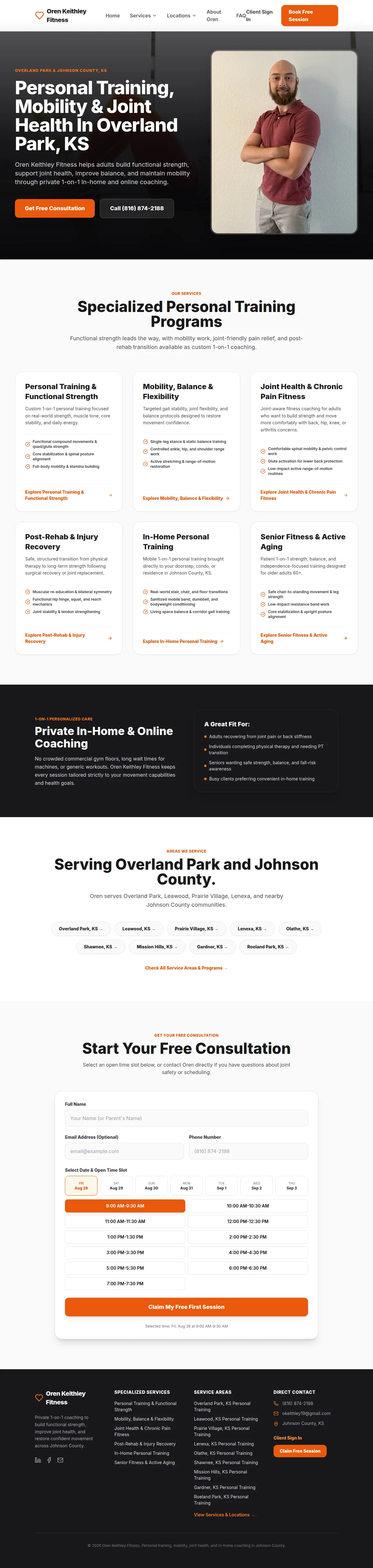
The homepage makes Oren visible, names the Johnson County service area, and explains functional strength, mobility, joint health, post-rehab fitness, in-home training, and active aging without turning the experience into a clinical promise.
Visitors can call, explore the program that fits their concern, review local service information, or move directly into the free-consultation workflow.
The live homepage connects Oren's human approach with clear services, locations, and consultation actions.
Where the project started
The original direction felt empathetic, but the system underneath it was narrow.
The earlier concept centered on one landing page, a browser-owned date and time picker, and client-side form handling. It communicated a compassionate fitness direction, but it could not own real availability, preserve a lead durably, or give each service and market enough room to answer a customer's question.
The goal was not to erase what already felt right. It was to preserve the tone while giving the business a dependable public structure and a booking process connected to Oren's actual Calendar.
How we approached it
Treat positioning, search, safety, and scheduling as one customer journey.
Clarify who the coaching is for
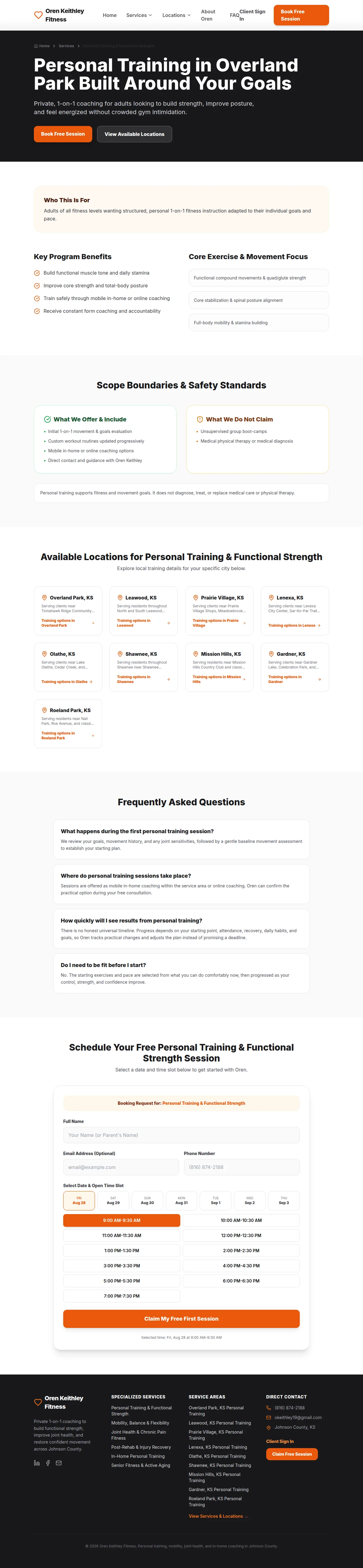
Six focused program paths explain the goals, exercises, inclusions, exclusions, and common questions behind Oren's work. Health-adjacent pages distinguish personal training from medical evaluation, treatment, and physical therapy.
Build local relevance without page inflation
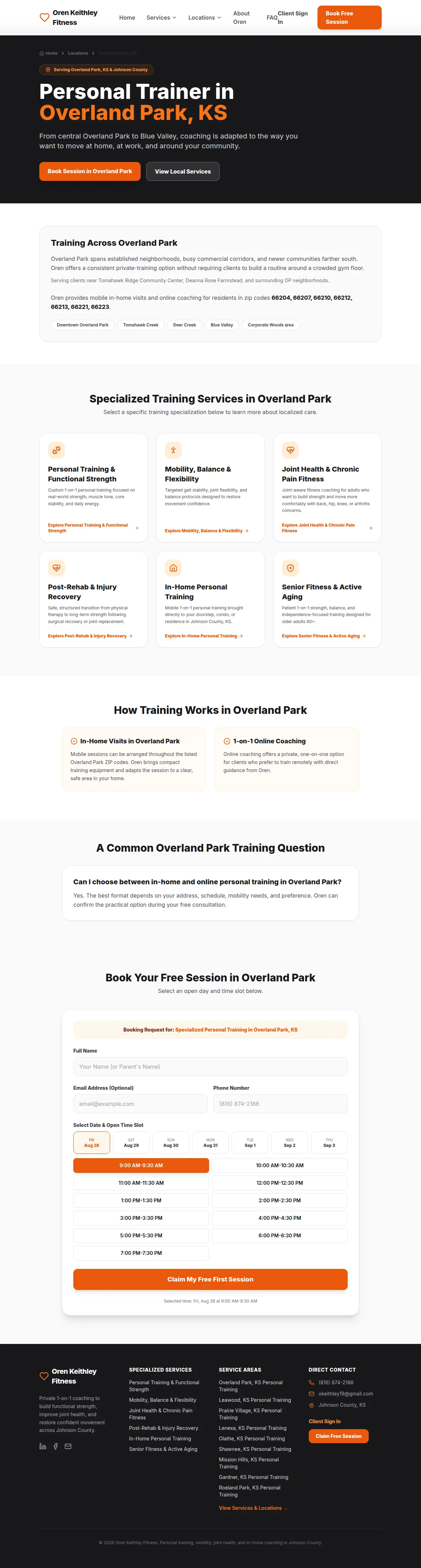
Nine city guides explain in-home and online options, practical service-area details, and local questions. A planned service-city matrix was retired instead of publishing dozens of thin, repetitive combinations.
Make booking belong to the backend
The browser displays current choices, while the server checks Calendar busy time and reserved lead slots, rechecks the selected interval, preserves the request in Sheets, and then attempts event creation.
Search and decision paths
Answer the service question and the location question without pretending they are the same.
Service pages explain the coaching itself. City pages establish where and how Oren can work with someone. They link to each other so visitors can move between need and location without forcing every combination into a separate page.
Service pages give specialized programs their own customer questions, scope boundaries, benefits, and next step.City guides explain local availability, in-home and online formats, neighborhoods, ZIP codes, and relevant service links.
Booking workflow
A time shown in the browser is not trusted as a booking.
01
Build availability from real constraints
The server creates the approved booking window, queries Google Calendar busy intervals, and removes times already represented by pending or scheduled lead rows.
02
Validate and recheck the selected time
Bounded customer fields, expected web origins, and rate limits protect the public endpoint. The exact interval is checked again immediately before either system is changed.
03
Preserve the request before creating the event
The lead is written to Google Sheets first with a pending status. If Calendar creation fails, the business still has the customer's request and requested time for manual follow-up.
04
Create and log the scheduling result
A deterministic Calendar event identity reduces duplicate effects. Successful scheduling updates the lead, while operational rows record lead capture, Calendar success, repeat-customer detection, and Calendar failure.
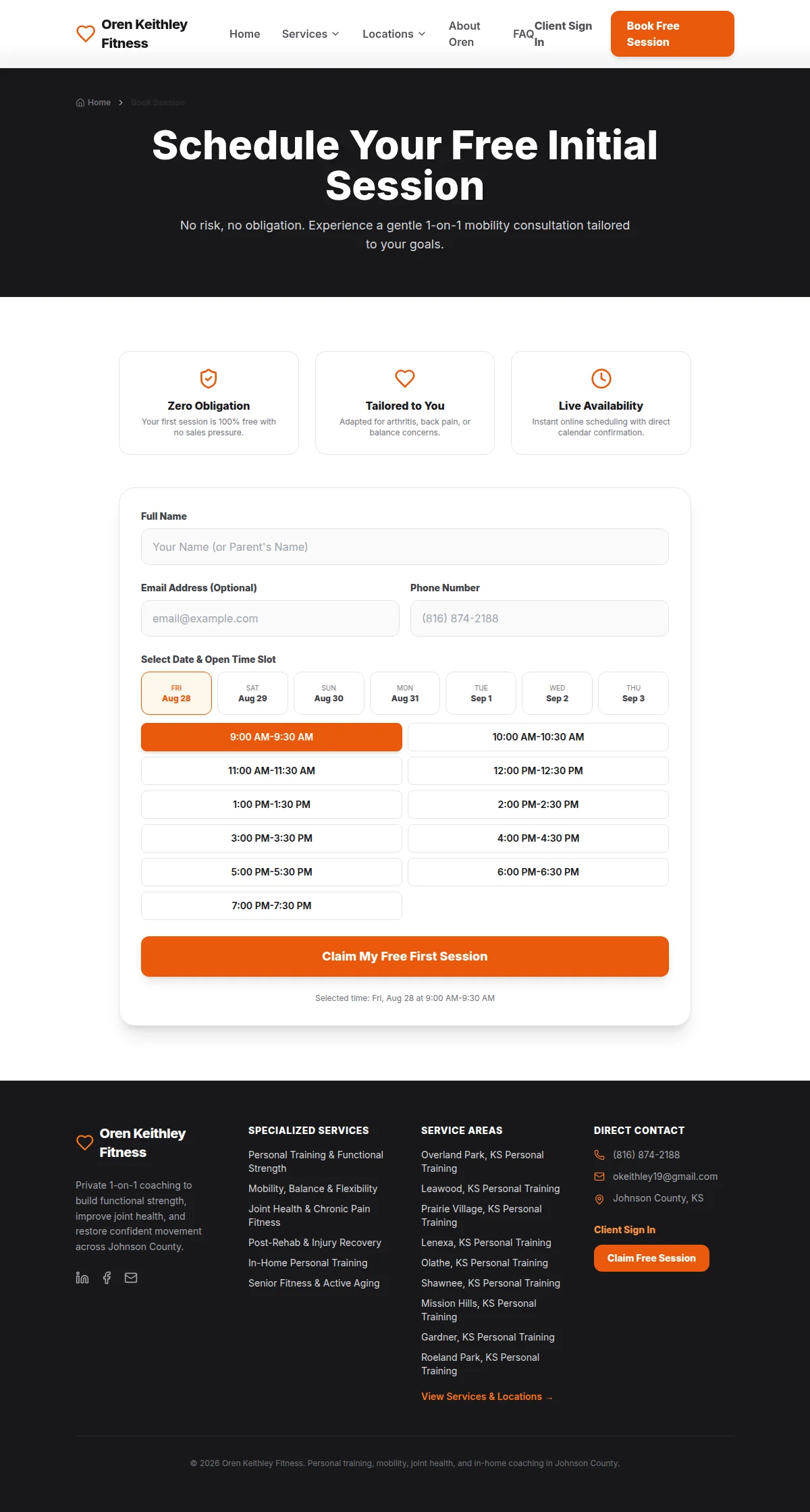
The public booking page requests current availability rather than inventing open times in the browser.
Live verification
The public website and availability service are operating on the intended domain.
On August 28, 2026, Tailored Approach rechecked the public homepage, XML sitemap, booking page, all twenty canonical routes, and the deployed availability endpoint. Every canonical page returned successfully, and the availability service returned current bookable windows in the configured business timezone.
The private Calendar, Sheets records, and client analytics are not exposed here. The write and recovery sequence is described from the reviewed production source; no traffic, ranking, lead, booking, conversion, or revenue result is inferred from deployment.
What changed
Oren now has more than a website that looks ready to help.
Customers have a structured place to understand Oren's approach, compare specialized coaching options, confirm the communities he serves, and request a real time from one connected experience.
Behind that experience, availability belongs to the Calendar, the lead is preserved before event creation, conflicts are checked again at submission, and operational outcomes remain visible when human follow-up is needed.
Respecting the client and the evidence
A live system is proof of delivery, not proof of business performance.
The public website, search architecture, and live availability experience can be reviewed directly. Oren's private customer records, Calendar, Sheets data, and analytics remain private. This case study makes no claim about rankings, traffic, inquiries, bookings, conversion improvement, health outcomes, or revenue without approved first-party evidence and a defined measurement period.
Google Analytics measures page use and form completions, not form fields. Off unless you allow it. Vercel's cookieless analytics stays on. Privacy policy.
Your browser's Global Privacy Control signal is enabled, so optional Google Analytics will remain off.